Email us! sales@amritahyd.org     |     Call us Today! +91 9393733174     |     We Are Open!  Mon - Sat 7 AM - 9 PM

Email us! sales@amritahyd.org

Call us Today! +91 9393733174

We Are Open!  Mon - Sat 7 AM - 9 PM

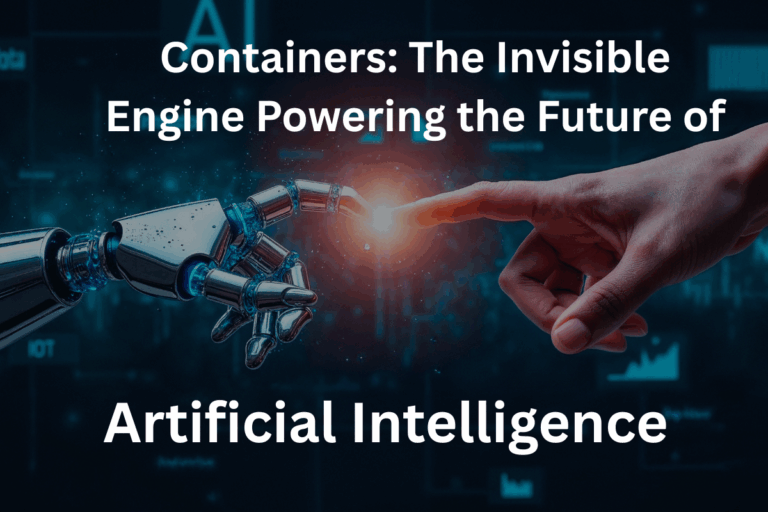
Containers: The Invisible Engine Powering the Future of Artificial Intelligence

Containers: The Invisible Engine Powering the Future of Artificial Intelligence

Artificial Intelligence has moved far beyond research labs and tech giants. Today, AI powers retail recommendations, financial fraud detection, factory automation, healthcare diagnosis, smart cities, and even personal assistants. As AI becomes deeply woven into everyday digital experiences, the demand for stable, efficient, and scalable AI infrastructure is skyrocketing.

Despite the glamour around GPUs, neural networks, and large language models, there is a silent hero enabling all this innovation — containers.

Containers may not be as flashy as generative AI or machine learning algorithms, but they have become the foundation for building, deploying, and scaling modern AI systems. Without containerization, today’s AI revolution would be slower, costlier, and far more complex.

This blog explores how containers are transforming AI development, why they are essential for large-scale AI adoption, and how they will shape the next decade of intelligent systems.

AI Is Getting Bigger, Faster, and More Complex — Containers Bring Order

AI systems today are not simple code snippets. They involve:

  • Large and diverse datasets

  • GPU-heavy processing

  • Multiple programming languages and libraries

  • Distributed systems

  • Multi-layered pipelines

  • Cloud + on-prem integration

  • Continuous updates

Managing all this complexity in a traditional environment is nearly impossible. Even the smallest inconsistency — a missing dependency, a mismatched library version, or a different OS configuration — can break an AI model.

Here is where containers bring clarity.

A container holds everything an AI workload needs: libraries, dependencies, runtime, configurations, and even specific hardware instructions. This means the model behaves exactly the same:

  • On a developer’s laptop

  • On an on-prem server

  • On a public cloud

  • On an edge device

  • Inside a production pipeline

This clean and consistent environment is crucial for AI development.

Why Containers Have Become the Standard for AI Workloads

1. Containers Remove Compatibility and Environment Issues

AI development is often slowed by environment mismatches. Developers struggle with:

  • Missing packages
  • Conflicting libraries
  • Different CUDA or GPU drivers
  • Operating system variations

Containers provide a repeatable environment, so AI teams do not waste time fixing system errors.
This speeds up development and improves engineering efficiency.

2. Containers Enable Massive Scalability for Model Training

AI training requires significant computational power — especially for deep learning or generative AI models. Scaling training across multiple machines, GPUs, or nodes is extremely complex.

With container orchestration platforms like Kubernetes and Red Hat OpenShift, organizations can automatically:

  • Add or remove compute nodes
  • Prioritize workloads
  • Allocate GPUs efficiently
  • Enable distributed training
  • Achieve better performance with less effort

This makes containerization essential for enterprise-level AI adoption.

3. Containers Accelerate Experimentation in AI Teams

AI is highly iterative. Models need:

  • Multiple experiments
  • Different versions
  • Hyperparameter tuning
  • Testing on various datasets

Containers let data scientists create isolated environments for each experiment without affecting others. With a single configuration file, an entire model environment can be replicated instantly. This massively boosts innovation speed

4. Containers Enable Hybrid and Multi-Cloud AI Strategies​

Few enterprises rely on a single environment. Data may live:

  • In private data centers

  • Across multiple public clouds

  • On edge devices

  • In on-prem HPC clusters

Containers allow AI workloads to move seamlessly across these environments without rewriting or reconfiguring code. This flexibility is essential for industries with high security demands like healthcare, banking, and government.

5. GPU Support Through Containers Makes AI Training Easier​

Modern container platforms can schedule GPU workloads intelligently. They know:

  • Which nodes have GPUs

  • How many tensor cores are available

  • How to balance training and inference loads

  • How to isolate GPU workloads securely

This makes containers perfect for handling advanced AI models that need GPU acceleration.

Containers Make AI Deployment Faster, Safer, and More Reliable

Building an AI model is only half the job. Deploying and maintaining it at scale is the real challenge.
This is where containers shine.

✔ Consistent deployment

The model behaves identically across all environments.

✔ Faster model updates (MLOps)

CI/CD pipelines can automatically:

  • Build model images
  • Test them
  • Scan them for security issues
  • Deploy them to production
  • Roll back if needed

✔ Secure and auditable AI systems

Container images can be scanned for vulnerabilities, helping prevent compromises and ensuring compliance.

✔ Efficient resource utilization

Containers are lightweight compared to virtual machines.
More workloads can run on the same hardware, significantly reducing AI infrastructure costs.

1. Generative AI and Large Language Models (LLMs)

LLMs require GPU clusters, optimized runtimes, and fast scaling.
Containers make it easier to deploy LLMs in:

  • Banking chatbots

  • Healthcare diagnosis systems

  • Customer support automation

  • Document summarization tools

2. Machine Learning Pipelines

AI pipelines often include:

  • Data ingestion

  • Pre-processing

  • Model training

  • Feature engineering

  • Testing

  • Deployment

Containers ensure each step runs smoothly and predictably.

Factories, hospitals, vehicles, and retail stores all need AI at the edge.Containers allow lightweight AI models to run with minimal resources on edge devices.

4. AI in Hybrid Cloud Environments

Organizations can run AI models where data resides, without moving sensitive information unnecessarily.

Security Becomes Stronger With Containers

With AI touching sensitive data — medical reports, financial transactions, customer identities — security becomes a top priority. Containers provide:

  • Image scanning
  • Role-based access control
  • Network isolation
  • Zero-trust configurations
  • Encrypted secrets
  • Compliance policies

These strengthen the overall security posture of AI deployments.

The Future: Containers Will Be the Core of AI Infrastructure

AI is becoming:

  • More distributed
  • More real-time
  • More personalized
  • More dependent on GPUs
  • More integrated into every industry

Containers are uniquely positioned to support this growth.

In the next decade, we will see:

  • AI agents running in containers across multi-cloud setups
  • Model updates happening daily through automated pipelines
  • Edge devices containerizing small and efficient AI models
  • GPU clusters managed entirely through Kubernetes
  • AI teams using container-native workflows as the default standard

Containers will become as essential to AI as electricity is to modern industry.

Conclusion

AI is growing rapidly, and the infrastructure behind it must keep pace. Containers offer exactly what modern AI systems need — portability, scalability, security, consistency, and speed. They help organizations reduce complexity, improve team productivity, and deploy AI solutions with confidence.

As AI continues to evolve, containers are no longer optional — they are the foundation for tomorrow’s intelligent applications. Without them, the next generation of AI innovation would struggle to scale.

The future of AI will be container-first, cloud-flexible, and deeply integrated with automated, secure, and GPU-optimized platforms — and containers will remain the quiet force powering it all.

Fill up the below Form